Your headline level
You get your score across six dimensions, scored 1 to 5, on a radar that's quick to read and easy to share with your leadership team.
See where your team stands with AI
In twenty-five questions over about eight minutes, you get a profile of your reported AI adoption across six dimensions. You can use it to compare perspectives with your team and choose a practical experiment.
Immediate results. No sales call required. Your result is on the screen the moment you finish.
Sample result · Level 1 · lowest reported dimension: People & Culture

“Pacemark was the first maturity model that showed my team where we actually stand, AND what to do next. Instantly clarifying.”
What you walk away with
You get your score across six dimensions, scored 1 to 5, on a radar that's quick to read and easy to share with your leadership team.
Your lowest score highlights an area to examine. It is a starting hypothesis, and your team’s evidence may point to a different priority.
You get a proposed next step to discuss and test with your team, with attention to the evidence, dependencies, and expected result.

“We brought in [Dan Cumberland Labs and Pacemark] to figure out where AI actually fits at a 250-person firm spread across 12 offices. They talked with almost a third of the firm before recommending anything, then handed us a clear, prioritized plan: what to do first, what to do later.”
What is Pacemark?
Pacemark structures your reported view across six dimensions and five levels, informed by company observations and academic research. Direct instrument validation is still pending.
How it works
Pacemark uses six dimensions to structure your reported view of AI adoption. The questions cover leadership, people, data, workflows, technology, and governance.
Is AI owned, funded, and named at the top?
How much of the company can actually use it?
Can your own data reach your AI tools?
Is AI inside the work, or just extra?
Sanctioned platform, or personal-account sprawl?
Do your AI rules hold when a deal's on the line?

“Most leaders know AI matters but don't know what to do first. Dan walked me through his maturity model and it does exactly that. It turns an overwhelming topic into a clear picture of where you are and the next right move. It gives the kind of clarity a team needs to make real progress.”
What your result looks like
Illustrative sample data: this example shows how Pacemark connects a maturity level, the lowest-scoring dimension, and a practical first move. Your result will reflect your own answers.
The lowest reported level sets this illustrative headline.
People use AI on their own. No strategy, policy, or one person steering.
Where the score comes from
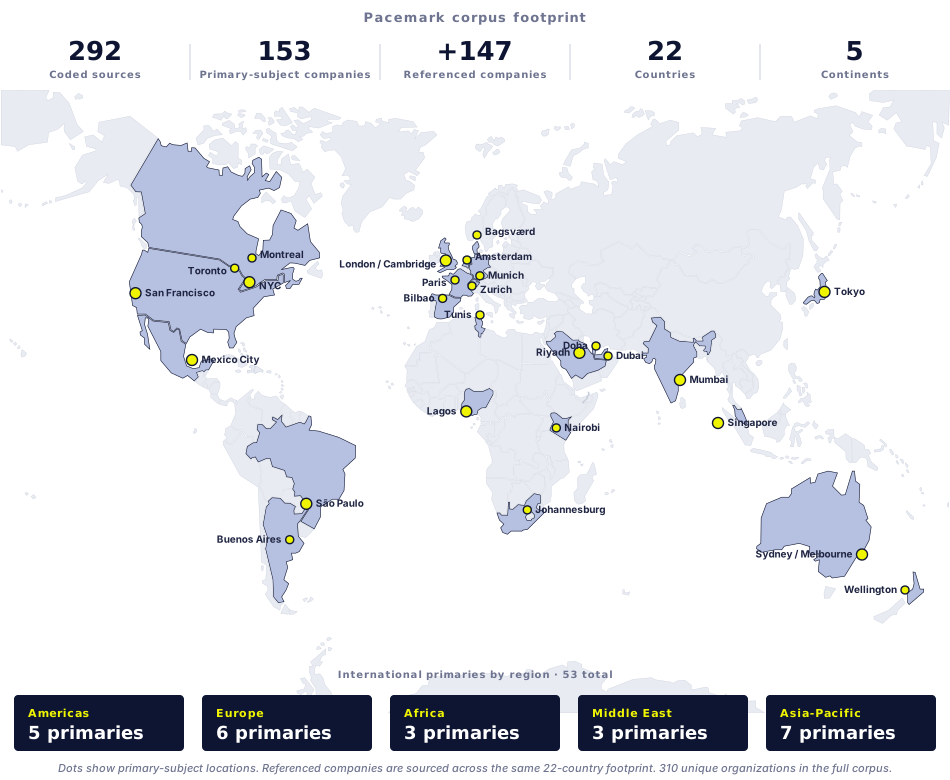
It started with interviews and case studies involving founders, operators, and the people doing the work. The corpus reviewed in September 2026 contains 308 coded source entries, with 169 companies studied closely across 24 countries and 300+ companies referenced overall. We also read eight outside references for context. Their methods and populations differ, so they do not provide a matching benchmark for Pacemark. The research hub separates these observations from the academic findings and our own hypotheses.
We built the six dimensions and five levels using the company corpus, and the academic review informs how we interpret them. You answer the assessment, it applies that framework, and your result appears when you finish. The score reflects your reported view and has not been directly validated. See the evidence and limitations.
Your result reflects your reported view. The lowest score highlights an area to examine; the full profile and evidence from your team help you decide what to test next.
Inside one engagement · a 250-person civil engineering company
"He raised our awareness of what's coming, pushed us to think hard about using AI responsibly, and worked with our team to build a practical roadmap for putting it to work."
 James Bledsoe, PEBoard Chair
"I knew AI was something I should be using, but I had no idea where to start. He changed that."
 Stillman Norton, PEArea Manager & Board Secretary
"As an outside board member, I've sat through a lot of presentations. His was engaging and educational, and it didn't matter what level of AI knowledge you walked in with— there was a way for every person in the room to take part."
 Julie ShiflettOutside Board Member · Founder, Northwest CFO
"[Dan Cumberland Labs and Pacemark] gave us a prioritized plan and the guidelines to adopt it responsibly. It was the right approach for us, and helped us get buy-in on using AI throughout the firm."
 Eric Roundy, PE, BCEESenior Wastewater Engineer & Board Treasurer
What companies get back
"Dan's AI infrastructure is changing everything for our agency— it's the foundation taking us from seven to eight figures."
 Amanda NorthcuttFounder & CEO, Level Up Creators
"Taking part in Dan's AI workshop was an excellent investment of my scarce time. Strongly recommend to speed up your learning curve."
 Nathalie Ramanantsoa-FratExecutive Advisor
"It generated in one minute seven emails that I can pull the trigger on immediately."
 Julie BollLeadership Coach
"The ROI is so worth it, it'll blow your mind. This has made my workflow so much easier."
 Mel Varghese, PhDFounder of "Selling the Couch"
Who it's for
You're a founder, COO, the ops or IT lead who everyone is looking to on this. The board is asking what the company's doing about AI. Maybe you can point at action, but the results are fuzzy. Pacemark is made for you.
Pacemark gives you a profile to discuss with your leadership team. You can compare it with the work your people do, examine the dependencies, and choose an experiment with an owner and a review date.


Who built this?
Pacemark is a Dan Cumberland Labs project. Dan Cumberland has built and sold software companies, and now works with engineering, construction, and professional-services firm leaders on putting AI to work— auditing how teams actually operate, building a roadmap, and standing up systems people use every day.
Pacemark grew out of that work and the research behind it: 169 companies studied closely within a corpus referencing 300+ companies overall. We use that evidence to frame questions about how your team adopts AI, and your answers provide a starting point for discussion.
See Dan Cumberland Labs →Twenty-five questions, about eight minutes, and you get your reported profile, an area to examine, and a proposed experiment. If you want to talk it through after that, the Signal Call is free, and your results set the agenda.